
Rolf’s ramblings
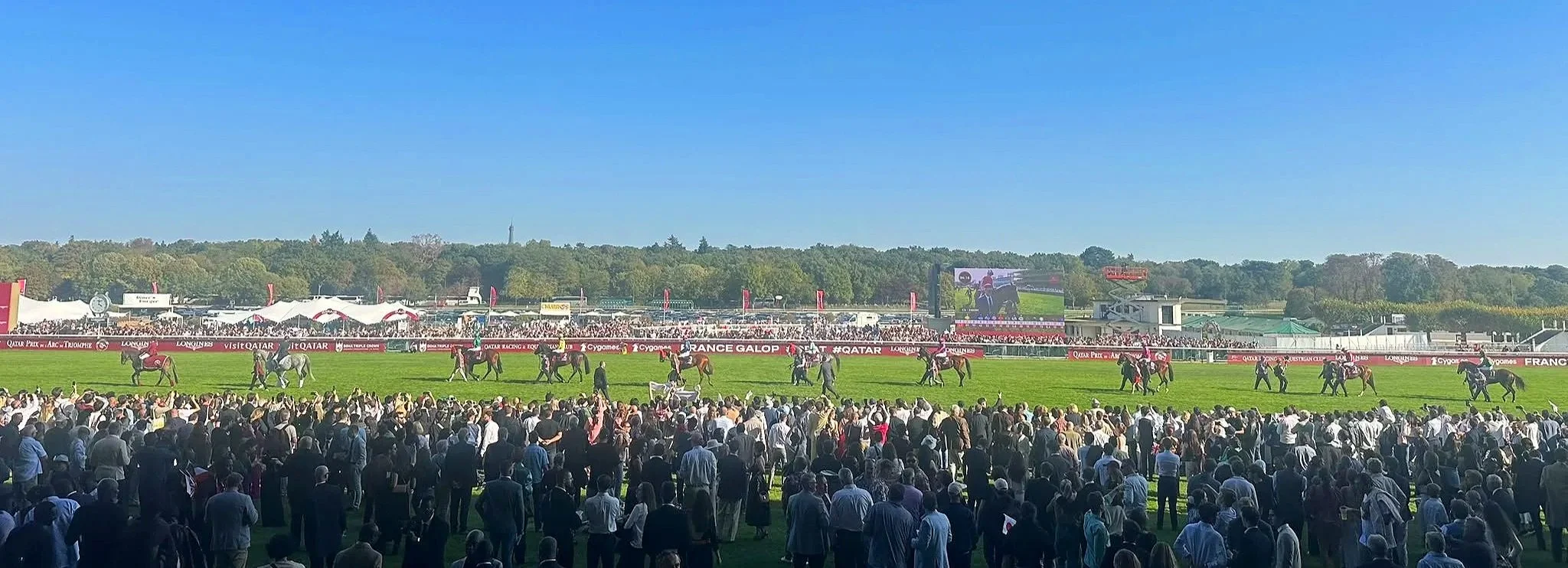
Prix de L’ Arc de Triomphe contenders parading before the race.
1859 was an important year – the founding of the Sporting Life of which Charles Dickens, an inveterate punter, approved; and the same year his A Tale of Two Cities was published. “It was the best of times and the worst of times” begins Dickens’ most famous novel, a vivid portrait of the bloody French Revolution. Daryz’s second Prix de l’Arc de Triomphe, the first time a colt has achieved that pinnacle since Alleged in 1978-9, was accomplished in the best of ‘times’, on the day, the first Sunday in October.
Defeat in front of Daryz’s adoring ‘turfistes’ might have provoked another Revolution.
But Dickens would surely have been sceptical about the status of the form – not the ‘worst of Arcs’ since its inauguration in 1920 but one limited by the overall quality of the sixteen-strong field. Daryz, deified by the media, provided the best of times on the clock, in summer sunshine at Longchamp, but showing form nowhere near as good as that of his sire Sea The Stars in the 2009 edition, on slower ground.
The going last Sunday was influenced by a heavy dew, the fresh strip of ground towards the far rail perfect for any horse. But the eulogies have gone stratospheric. The French newspaper Le Monde said at the time of Sea The Star and the colt’s stunning success, “Only lightning and tragedy are indelible”. Similar hyperbole is now bandied about Daryz.
Sea The Stars then retired to stud – as Daryz will do. He was the ninth horse to win the Arc in successive years in front of 24,000 fans cheering home their favourite, a crowd incidentally, about the same as that for the Derby. Longchamp is more compact, enclosed by the Bois de Boulogne, without the Downs that stretch Epsom’s viewing area, but it was still a disappointing number considering the clarion call plastering the Metro: “Je Y Vais” - “I’m off” (to Longchamp).
Alleged was rated 138 for the first of his Arcs with Lester Piggott, and 140 for the second. Daryz’s ratings have not changed from 127 since his first Arc and it will take a lot of gerrymandering by France Galop handicappers to raise that figure substantially for Sunday’s triumph – even taking into account that fast time. (In fact the French handicapper raised Daryz’s mark to 130).
Second and third, Bay City Roller and Diamond Necklace, had to race from ‘coffin’ draws out in the Bois – 15 and 16 of the sixteen stalls, and yet George Scott’s four-year-old colt and Coolmore’s three-year-old filly finished within two lengths of Daryz. And the first ten home were all within five lengths of one another. The achievement of dual victory is commendable; the substance is debateable.
Though Barzalona rode an exemplary race on the winner, avoiding any need for the excuse of traffic problems by coming wide, the former champions of Britain and France, Oisin Murphy on the runner-up and Christophe Soumillon on the third, worked miracles to get their mounts so close. Or maybe their passages were just evidence that this was not the greatest of Arcs.
Bay City Roller’s run, along with George Scott’s winners, Wimbledon Hawkeye in the Group 2 Prix Dollar and Caballo de Mer in the Group 1 Prix Cadran, must be career-changing for the youthful Newmarket trainer. Paris-Turf called it his “ascension”. Scott’s Eve Lodge Stables, one of whose former occupants was Lester Piggott, will surely bulge. Bay City Roller finished almost precisely the same distance behind Daryz as he had done in the Prix Foy Arc Trial at Longchamp last month, solid form, yet as admirable an animal as the son of New Bay is, in four previous visits to Longchamp Bay City Roller had never tasted victory.
The fantasy that is racing was never better illustrated than Scott’s second victory in the Cadran with Caballo de Mer who gave him his first Group 1 winner in the same race a year ago. Caballo de Mer won his first handicap two years ago off a rating of 67 and overturned defeat by 63 lengths in the Ascot Gold Cup in this photo finish victory over the same horse, Scandinavia.
Scandinavia’s defeat at long long odds on meant that Aidan O’Brien and Coolmore had to wait til the last Group 1 of the meeting, the Prix Foret, for their first winner, with One Thousand Guineas heroine True Love.
On strict calculations (and what other calculations should there be?) Daryz is not the talisman that racing seeks. He provided a marvellous spectacle with his sweeping run on the outside, but if we accept the time of the race, we can’t by the same token discard the form figures.
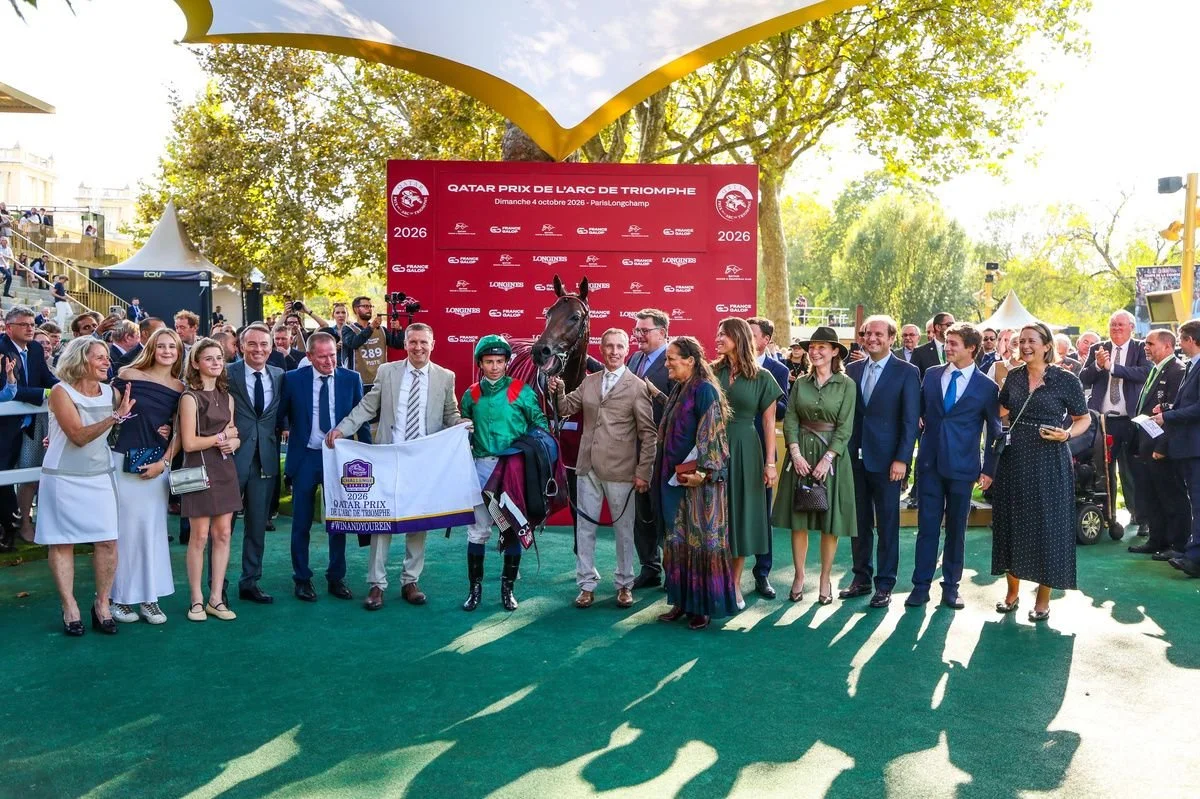
Aga Khan connections celebrating Daryz’s victory.
In her post-race Press address, the late Aga Khan’s daughter Princess Zahra Aga Khan was justifiably resolute regarding Daryz’s future – at the Haras de Bonneval in Normandy. It is worth recording here the family’s association, through their breeding achievements, with the world’s greatest race. With their ninth victory the Aga Khan family extended its own record in the race. It is hardly likely that this was the last to carry the green colours with red epaulettes to Arc victory and at least as certain it will not be the last for France’s outstanding trainer of his era, Francis-Henri Graffard, composed on the surface but emotions betrayed by trembling hands, it was a great relief. Another sign of the times, though not from his demeanour, was that Andre Fabre, record-holding winning-trainer in the Arc with eight wins, had but two runners in the Group Ones. at the two-day meeting – nothing in the Arc. The times for this true great have moved on.
Last year was a sentimental Arc; emotions were to the fore. The Aga Khan had passed away. Princess Zara Aga Khan was once again serene as she addressed the post-race question and answer with the international Press, concentrating on Daryz’s future. It was not influenced by the death of two horses at the meeting.
“I was caught up in the moment (last year),” the Princess responded elegantly. “We’re breeders. We take a risks when we run him. He has other things to do now.”
The best ‘good news story’ of the weekend was surely that of the claiming rider Jack Nicholls’ minute victory on Miss Yechance in the Abbaye. Given that Karl Burke’s stable were in mourning after disaster struck their five-time Group 1 winning filly Fallen Angel in the previous day’s Prix Daniel Wildenstein, Miss Yechance brought redemption – to a degree.
Bred by the Aga Khan’s Studs, Miss Yechance only arrived at Burke’s yard in June, to be beaten off a handicap mark of 86. Progressing rapidly, she won Group3 at Newbury last month. Her jockey, Jack Nicholls, still has twenty-three winners to find to become a fully-fledged jockey and was on a bit of a losing run, if not exactly the cold list.
Nicholls contained his excitement, still with a slightly glazed air at the post-race Press conference and addressed his audience with aplomb. But then he had just beaten the Graffard-Barzalona combo in a Group 1 photo finish in a race his grandfather David ‘Dandy’ Nicholls also won in a photo finish, on Continent in 2004!
Daryz’s repeat victory, of course, made all the headlines. His triumph on behalf of some of the most potent bloodlines in existence, was also appropriate because it was the last Arc confined to horses capable of breeding their successors. In 2027 geldings are allowed, for the first time, into this race, the golden lode of the thorough bred breeding industry. Many racing folk – not all fossils - have expressed regret at losing the fight to forestall the eventuality. For all the ‘purists’ it will be the worst of times. For its proponents – vive la revolution.